
Self-Assessment Feedback for parents.
This blog article includes results from Google’s Artificial Intelligence search engine about the “self assessment feedback method.”
Hey struggling parent. Has this ever been you?
Repeating instructions too frequently.
Overwhelmed with frustration about your child(ren)’s choices.
Losing sleep over the possibility of traumatizing your child(ren) due to your parenting style.
The self assessment feedback method can help turn the tide in your relationships with your kids, and hopefully bring a lot of peace to your final years of child-rearing before your “empty nest” season arrives!
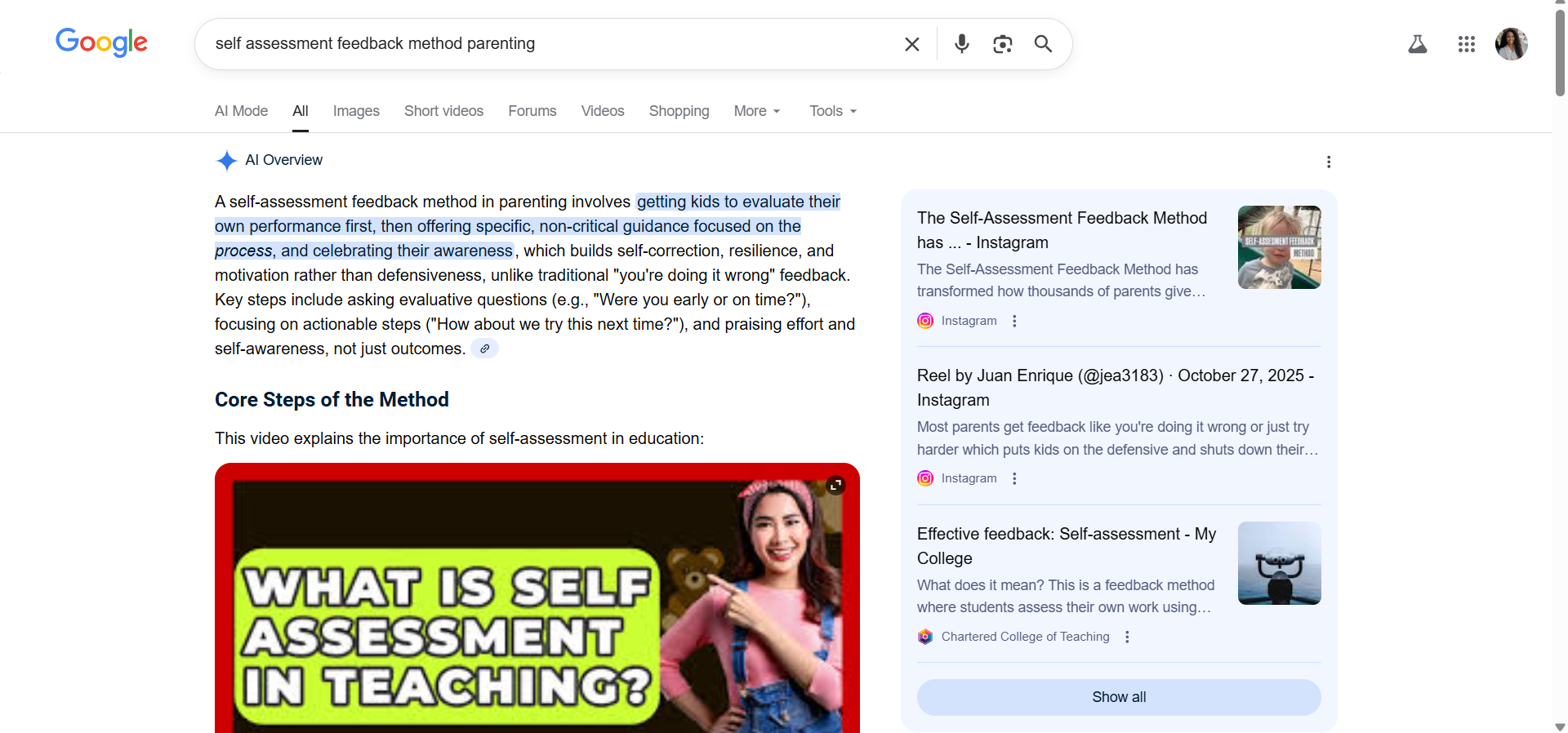
So, what is self-assessment feedback?
A self-assessment feedback method in parenting involves getting kids to evaluate their own performance first, then offering specific, non-critical guidance focused on the process, and celebrating their awareness, which builds self-correction, resilience, and motivation rather than defensiveness, unlike traditional "you're doing it wrong" feedback. Key steps include asking evaluative questions (e.g., "Were you early or on time?"), focusing on actionable steps ("How about we try this next time?"), and praising effort and self-awareness, not just outcomes.
Benefits for Children
Develops Self-Correction: Builds internal skills to fix mistakes.
Reduces Defensiveness: Shifts focus from external judgment to internal improvement.
Increases Motivation: Fosters intrinsic desire to learn and persevere.
Boosts Resilience: Teaches them to handle frustration and failure constructively.
Example Scenario
Instead of: "You're not hitting the ball right!"
Try: "How did that last swing feel? Where do you think the ball went? Next time, let's focus on keeping your eye on the ball all the way through.".
How to Implement It
Ask for Self-Evaluation: Prompt the child to rate their own performance or effort before you offer input (e.g., "How do you think that went?" or "On a scale of 1-5, how well did you do that?").
Provide Process-Focused Guidance: Instead of criticizing the person ("You're lazy"), give specific, actionable advice on the task ("Next time, let's try putting your shoes by the door before dinner").
Celebrate Awareness & Effort: Acknowledge their self-assessment and effort ("Great job noticing that you got distracted!").
Use Clear Criteria: Give them SMART goals, numbers, measurable outcomes, rubrics or checklists so they know what to assess.
Be Interactive: Frame feedback as questions to encourage thinking ("What do you think would happen if...?").
Focus on the Future: Help them set goals based on their self-assessment.
This method, adapted from educational psychology, turns feedback into a collaborative learning experience, empowering children to become confident, self-directed learners.
Has the self-assessment feedback method been working for you and your child? Share your success story with us!