
Myth buster: pure altruism is just a theory.
First, let’s define Altruism:
n. selfless concern for the well-being of others, without care for one's own interests; unselfishness.

So, in theory, altruism would be the character trait that allows a person to run into a burning building, without regard for their own life, in order to save their pet cat from the flames, or their little sister from the unyielding heat and smoke.
Sounds good and honorable, right? It sounds like if everyone operated with more altruism, the world would be a much better, happier place.
There’s just one problem.
Few people realize that altruism is often confused with another similar psychological theory called “pure altruism.”
Pure altruism is the act of helping others based solely on a selfless concern for their welfare, with ZERO expectation of personal gain, reward, or benefit. This means that all self-interested motives, both conscious and subconscious, are completely absent.
Altruism, or general unselfishness, is truly an honorable virtue. However, PURE altruism may not actually exist. It is just a theory! It is also a slippery slope that plagues too many people’s interpersonal interactions. Here’s an example of what I mean. Let’s take a look at a hypothetical couple, who we will call Sally and Harry…

Sally doesn’t realize it, but she believes in the the theory of pure altrusim. Sally believes pure altruism exists and that she can love someone completely void of selfish motives or selfish intent. Sally and Harry’s love story went like this:
Sally and Harry fell in love.
Harry asked Sally to move in together.
Sally felt uncertain whether this was the best decision, because Sally wanted to get married before moving in with someone. Also, Harry’s income was significantly lower than Sally’s, and Harry did not want to marry or combine incomes until after he met his financial and career goals.
Sally decided to move in with Harry, because Sally loved Harry, didn’t want to lose him, or slow down a good thing. She was hopeful everything else would work itself out over time.
Harry felt the same way and was hopeful they would build a beautiful life together. However, after the move, Harry struggled to increase his income, and over time he began to feel like a financial burden to Sally, rather than an equal partner in their relationship.
Sally tried to reassure Harry that she loved him with no expectations or conditions, and that she could love him beyond his financial struggles. She believed in him and was willing to support him even if he never achieved his financial and career goals.
Sally’s support was appreciated by Harry, but Harry soon fell into a depression due to his own self-doubt and pity. His feelings were only amplified by Sally’s unwavering financial support and love, spiraling Harry further and further into a pit of despair.
After 4 years of living together, Sally began to feel unloved by Harry, because his actions did not seem to match his words. He said he loved her, but he never proposed to her and she feared he might never commit to her in marriage due to his ongoing financial and emotional difficulties. When Sally tried to talk to Harry about this, Harry seemed to distance himself more from Sally.
Eventually, Sally decided to leave Harry. A part of her still loved him, but another part of her was exhausted and unsure how much longer she could single-handedly carry the financial and emotional burden of the relationship. She realized she wanted something that felt more mutual, and couldn’t understand why someone as wonderful as Harry would not choose to love her better, even though he was going through difficult times. Sally thinks to herself,
“When I am going through difficulties, I still make sacrifices so others feel loved! Why doesn’t anyone seem to do the same for me?”
Where did Harry and Sally go wrong? Perhaps Sally could realize her world is clouded by the theory of pure altruism. If she did, she would approach new and current relationships with realistic expectations on herself and others. If Sally had done this with Harry, she would have been honest with herself about her desire to be married before moving in with him, and she would have been more assertive about her need for commitment and emotional safety within a long-term relationship. Instead, in the name of “love” from a purely altruistic standpoint, Sally insisted upon ignoring her own boundaries in hopes it would make room for Harry’s needs and eventually solve their problems.
The theory of pure altruism is just that- a theory. It is not a foundational principle upon which relationships should be built. Integrity, dignity, mutual respect, trust and love are wonderful foundational principles for relationships. Pure altruism sounds like an honorable trait or quality, but it does not help us to meet our basic human needs, many of which we can see below in Maslow’s heirarchy of needs, circa 1943.
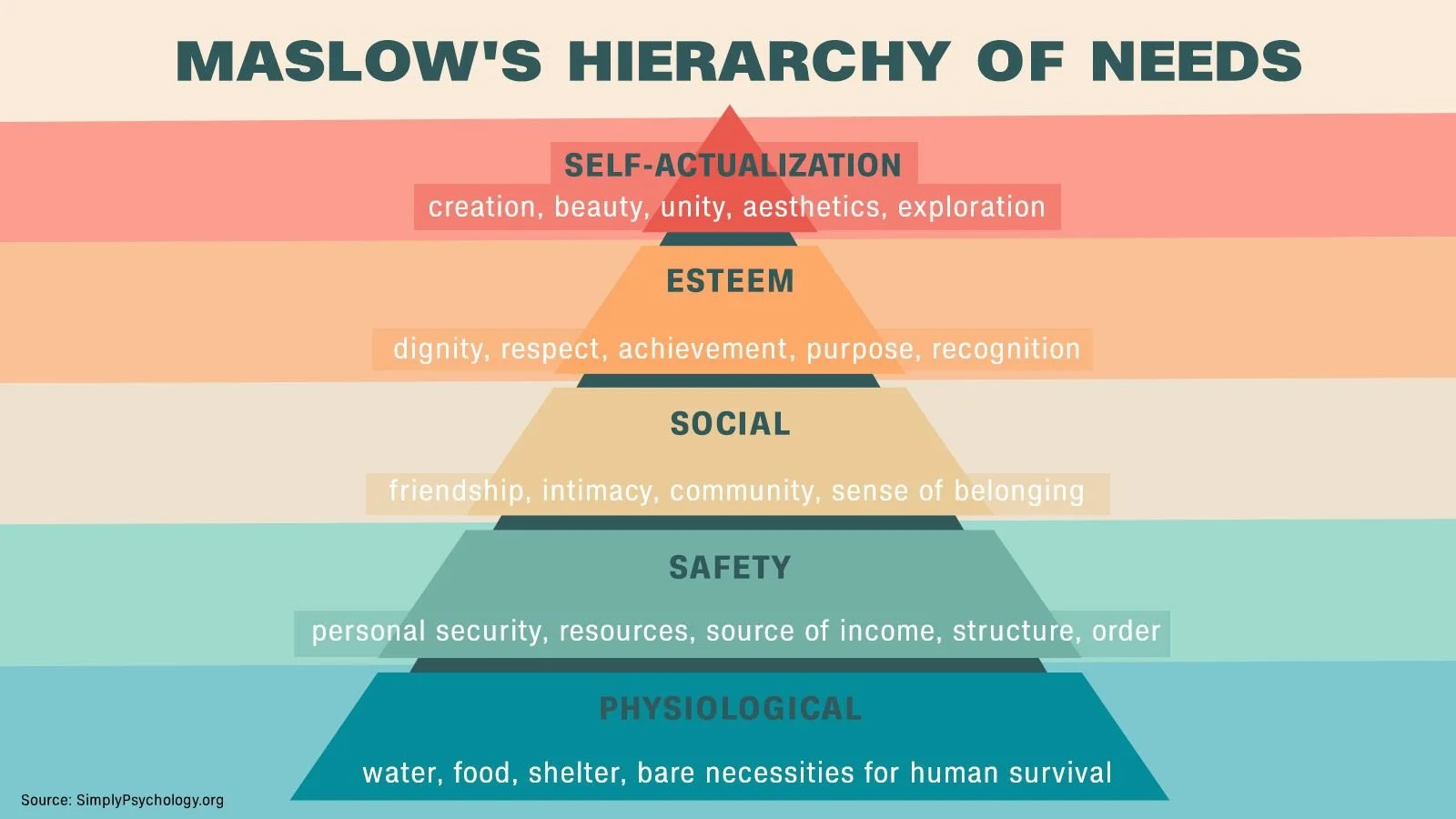
Not all of our needs are physiological. Those are simply the foundation of survival. To feel fully alive, humans also need to achieve, live with purpose, create, connect, belong, and experience the many complex and beautiful parts of life that make us whole.
Being selfless and performing acts of altruism can help meet these needs, but the idea of pure altruism suggests those needs don’t exist at all. It assumes we can set aside our individual desires and act only for the benefit of someone or something outside ourselves—without even a subconscious motivation behind it.
I refuse to live that way. Trying to be purely altruistic, even for a moment, ignores the reality of my human needs, values, and existence. I believe in selflessness and altruism, but I will never confuse that with pure altruism. The idea that I behave selflessly simply because “I love unconditionally,” without expecting anything in return or caring about the outcome, would not be true for me.
“But isn’t this what Jesus is famous for? Didn’t he sacrifice his life on a cross as a purely selfless display of unconditional love? If anyone is an example of pure altruism, that it actually exists and is more than just a theory, the life of Jesus is… right?”
Wrong…

“…Looking unto Jesus the author and finisher of our faith; who for the joy that was set before him endured the cross, despising the shame, and is set down at the right hand of the throne of God." -Hebrews 12:2 KJV
According to Hebrews 12:2 Jesus endured the cross, disregarding its shame, “for the joy set before him.” This "joy" signifies his triumph over sin/death, his return to the Father's right hand, and the redemption of his people.
I once heard a pastor say, “…and who came up with this idea of (pure) altruism? Not God! Even Jesus had an expectation that his sacrifice would yield a return.” According to the Bible, God’s unconditional love is given unconditionally. Meaning, even if his expectations are not met, he still chooses to love… that does not mean he has zero expectations at the start. If God is not purely altruistic, why do so many think he expects us to live that way? God seems to make his expectations very clear in the Bible, over and over and over, to those he loves… perhaps we can learn something from that model.

Hey! Don’t get mad at me, the Bible said it first! I’m just relaying the message.
Since learning about the theory of pure altruism, I’ve almost always been able to trace my choices back to some expectation for the outcome. Lately, though, I’ve also been learning that I can let go of those expectations—even while acknowledging that they exist.
For example, when I show love to my husband or my one-year-old son, there may be subconscious expectations behind my actions. I hope and expect them to feel at peace, to experience happiness, and that they will show love towards me and others. I hope we build a healthy family dynamic—a household that supports one another through hard times and celebrates together in good ones.
I’m not consciously thinking about these things while washing dishes or folding laundry, but somewhere beneath the surface, I recognize an expectation for something to grow from even the smallest of my daily investments.

My incredible husband and I, married since 2019, celebrating our 3-year anniversary.
Being self-aware of my expectations helps when difficult emotions begin to rise. Instead of being caught off guard, I can slow down, listen, and learn from them. What is this emotion telling me about my disappointment, my struggles, or my heartache? What does it reveal about what I hoped for, needed, or wanted to be different?
Making space for my expectations—and acknowledging them honestly—helps me become a better partner, lover, mother, therapist, and friend.
Whenever I help someone, I naturally hope that my help improves their situation. And if it doesn’t, I at least hope to learn why. When I choose to act selflessly, I believe those actions matter. I hope they are not in vain. Even if the person receiving my help does not benefit directly, I trust that something good may still come from it—somewhere down the line, in my life or in the life of someone I may never meet.
My altruism is part of a greater good. My expectation is simple: that somehow, in some way, it helps someone.
Don’t fall for the myth of pure altruism. Instead, become aware of your own expectations. Give yourself permission to explore them and accept them for what they are. Recognize your desire for certain outcomes, and when it serves you, practice letting those outcomes go. Share your boundaries, needs, and values with others.
Doing so will strengthen your relationships—and one day, you’ll thank yourself for it.